Turnload · Guide
Unaccompanied ro-ro: the trailer crosses alone, then it waits
In unaccompanied ro-ro, the semi-trailer goes on the ship and the tractor and driver stay ashore. A growing share of trailers crosses to, from and around Italy this way, and it changes where a trailer spends its time. The ship moves the unit on schedule. Before and after the crossing, it stands. This guide covers how much Italian ro-ro now travels unaccompanied, where the idle days come from, what 2026 adds to the bill, and how a paid move can take the place of the wait.
What unaccompanied ro-ro is
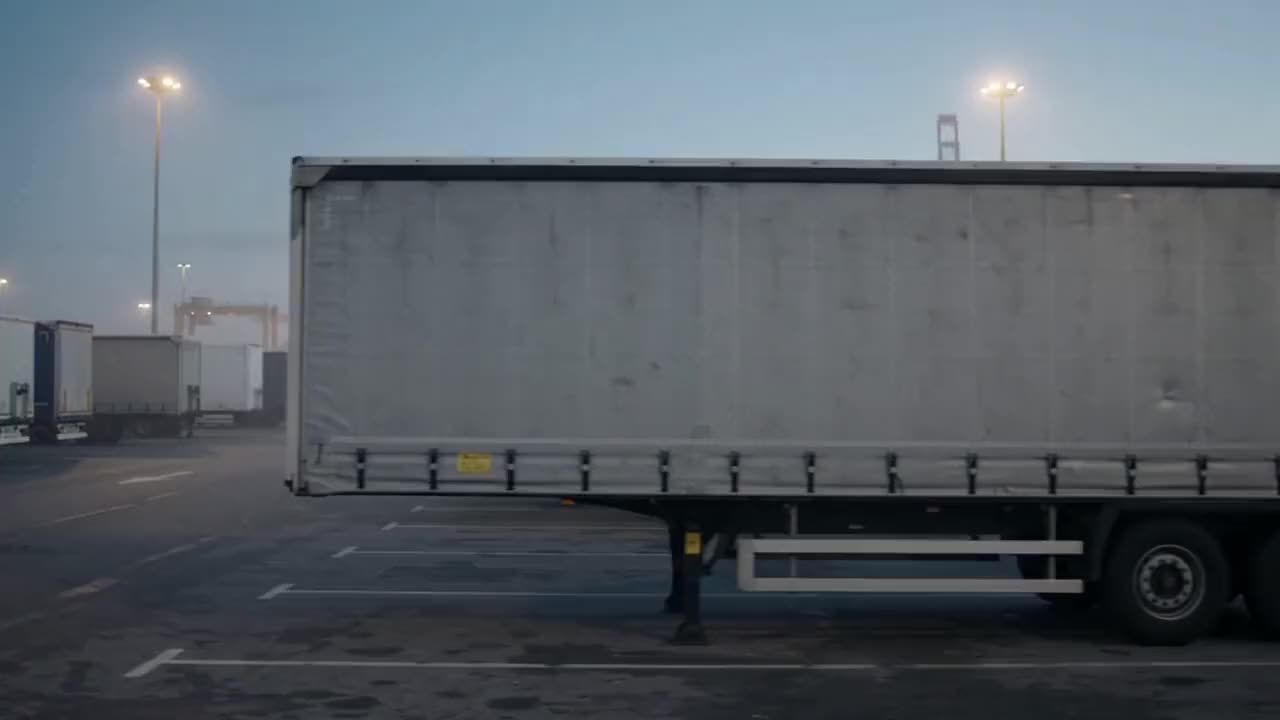
On an unaccompanied crossing, a tractor drops the semi-trailer at the departure terminal and leaves. Terminal tractors load it onto the ship, unload it at the other end and park it in the arrival terminal, where another tractor collects it. No driver sails with it.
| Accompanied | Unaccompanied | |
|---|---|---|
| What boards the ship | Tractor, trailer and driver | The semi-trailer only |
| At the arrival port | The driver drives off and carries on | The trailer stays in the terminal until a tractor collects it |
| Time without a tractor | Little: the tractor stays coupled | Built in, at both ends of the crossing |
In unaccompanied ro-ro, a trailer without a tractor is not a planning slip. It is how the service works. That makes the idle time predictable, and you can plan around predictable time.
How much Italian ro-ro now travels unaccompanied
- 50.7%
- of Italian short-sea ro-ro tonnage moved unaccompanied in 2024, up from 40.8% in 2015 (Turnload calculation from Eurostat, 2026a, 2026b).
- 6,160,189
- ro-ro units handled by Italian ports (Assoporti, 2026).
In 2024, for the first time, more than half of Italian short-sea ro-ro tonnage crossed without a driver. We calculated the share ourselves from Eurostat’s maritime tables and checked it against a second dataset, which gives 50.3%. Note what each figure counts: the share is measured in tonnes, the Assoporti total in units. Because they are different measures, one cannot be applied to the other to give an exact count of unaccompanied units.
Ro-ro traffic runs through Italian ports such as Genoa, Livorno and Catania, linking the mainland with Sicily, Sardinia and the rest of the Mediterranean. If you send trailers to or from Italy from Germany, Austria or the Benelux, you are shipping into a market where the driverless share has risen by almost ten points since 2015.
Why trailers stand idle at both ends of the crossing
Before the sailing
The trailer has to be at the terminal before the cut-off, so it often arrives hours ahead, sometimes the day before. If the sailing is full, it waits for the next one; if the ship is late, it waits longer. The tractor that brought it has long gone.
After arrival
At the arrival port the trailer stands in the terminal until a tractor collects it. If the owner has no tractor at that port, or no load for the next leg, it waits for both. The crossing runs to a timetable. The wait on the quay does not.
More freight one way than the other
Many lanes carry more freight in one direction than the other. Trailers then pile up at the end where little goes back, and their owners either pay to bring them home without a load or leave them standing. On ro-ro lanes, with fixed ports and published schedules, this imbalance repeats week after week. It is predictable, not random.
Terminals already bill the wait. DFDS’s Rotterdam terminal charges €31 per day after 72 free hours, and €91 per day from day 9 (DFDS, 2026). On top of any storage fee, a semi-trailer worth about €30,000 (Luman, 2026) earns nothing while it stands. Check the tariffs at the terminals you use, and see what each standing day costs your fleet.
What 2026 changes: ETS surcharges and Sea Modal Shift
The EU Emissions Trading System has covered shipping since 2024. Shipping lines paid for 40% of their reported emissions in 2024 and pay for 100% from 2026 (European Commission, 2026). In 2023 Grimaldi and GNV announced ETS surcharges passed on to hauliers: increases of up to about €180 per crossing for an articulated lorry, as reported by Shipping Italy (Redazione Shipping Italy, 2023). The Sicilian hauliers’ association AITRAS put the extra cost at over €260 per crossing (Redazione Shipping Italy, 2023). An empty unit on the ship pays the surcharge just as a loaded one does.
Italy’s Sea Modal Shift scheme pays the haulage company, not the shipping line, up to €0.30 per embarked unit for each kilometre of national road avoided (Redazione Shipping Italy, 2026). That is a cap, not the payout: in the first annuity, hauliers claimed about €240 million against €52.9 million available, and the payout was pro-rated to about €0.06, 80% below the cap (Redazione Shipping Italy, 2026). The demand is real, but plan with the real figure. Moving trailers by sea has to pay without the subsidy.
How Turnload approaches unaccompanied ro-ro
Turnload treats the wait as capacity another carrier can use. A trailer goes in idle and comes out on a paid move.
- FlagMark which trailers are standing, where, and since when. Your fleet data already has this. Nobody sees your prices, customers or order book.
- MatchTurnload looks for a return load or a repositioning move on the lanes you already run, by road or by sea. When you know a trailer will stand, the move can be lined up before it does.
- Hand overYou and the other carrier sign the hire directly, on terms you both already know. Photos and timestamps at pick-up and return show who had the unit, and in what condition.
- Get paidThe trailer earns on days it would have spent parked. We report utilisation per unit, so you can see the change in your own numbers.
Unaccompanied ro-ro is where a trailer without a tractor is the rule. The same problem turns up on every lane where a trailer ends up in the wrong place: see our guide to repositioning moves. Turnload matches idle trailers to a return load or a repositioning move, on road, ro-ro and the other ways your trailers travel. We are opening to the first fleets soon.
Sources
- Assoporti. (2026). Movimenti portuali 2025 [Statistical report]. https://www.assoporti.it/it/autoritasistemaportuale/statistiche/statistiche-annuali-complessive/movimenti-portuali-2025/
- DFDS. (2026). Rotterdam terminal tariff 2026 [Tariff document]. https://assets.ctfassets.net/mivicpf5zews/3257rV77eotNMjhacYWJtS/ecefa2f78473f4d0722c4385f0c64520/RTM_Terminal_Tariff_2026.pdf
- European Commission. (2026, May 6). Reducing emissions from the shipping sector. Climate Action. https://climate.ec.europa.eu/eu-action/transport-decarbonisation/reducing-emissions-shipping-sector_en
- Eurostat. (2026a). Country level - gross weight of goods handled in main ports, by type of cargo (mar_mg_am_cwhc) [Data set]. https://ec.europa.eu/eurostat/databrowser/view/mar_mg_am_cwhc/default/table
- Eurostat. (2026b). Short sea shipping - country level - gross weight of goods transported to/from main ports, by type of cargo (mar_sg_am_cwk) [Data set]. https://ec.europa.eu/eurostat/databrowser/view/mar_sg_am_cwk/default/table
- Luman, R. (2026, January 15). How replacements will drive the European trailer market’s recovery. ING Think. https://think.ing.com/articles/european-trailer-market-recovery-on-replacements/
- Redazione Shipping Italy. (2023, December 14). Annunciati da Gnv e Grimaldi i rincari per l’Ets: fino a 180 euro a tratta sulle autostrade del mare [GNV and Grimaldi announce ETS increases of up to 180 euros per crossing on the motorways of the sea]. Shipping Italy. https://www.shippingitaly.it/2023/12/14/annunciati-da-gnv-e-grimaldi-i-rincari-per-lets-fino-a-180-euro-a-tratta-sulle-autostrade-del-mare/
- Redazione Shipping Italy. (2026, June 23). Contributi Sea modal shift inferiori dell’80% alla domanda delle imprese [Sea Modal Shift contributions 80% below business demand]. Shipping Italy. https://www.shippingitaly.it/2026/06/23/contributi-sea-modal-shift-inferiori-dell80-alla-domanda-delle-imprese/